
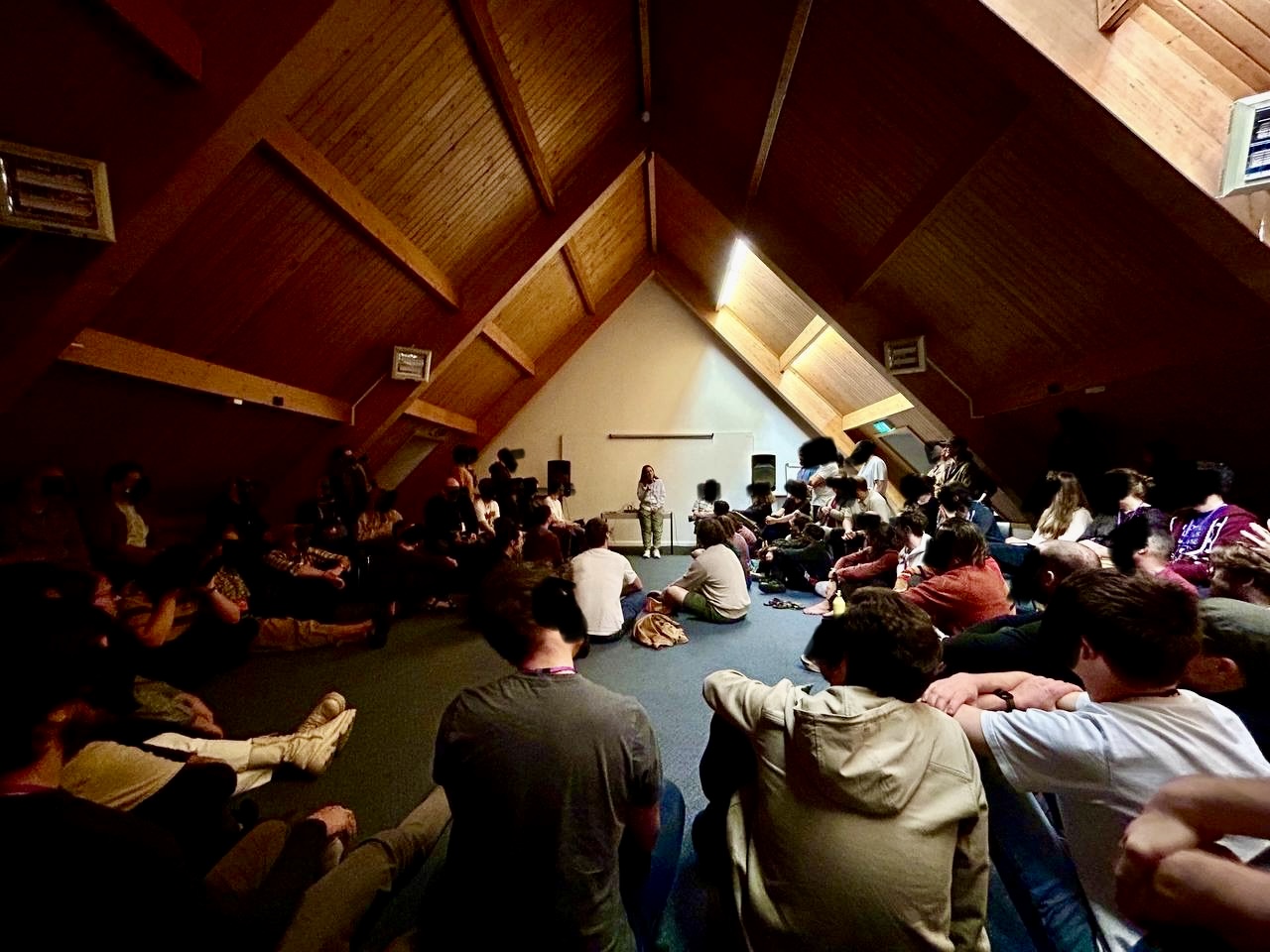
This post aims to reflect on and distil my knowledge from my experiences with running events from a practical perspective. It barely covers the practicalities, and perhaps I’ll write up a second post on things I’ve forgotten.
Likely you already have a vision for the event, a sense of theme, goals and vibes. This is necessary to begin to coalesce the shape of your event, but in general most people already have this vague outline set up from their own desires. What follows here is more about the practicalities of how to make it happen.
Circular Dependencies
One maddening thing about events is, everything depends on everything else. Your audience will say they can only come depending on the date, the date can depend heavily on the availability of your venue, and your venue depends heavily on the number of people who can come to your event. ARGH!
Catch-22s or circular dependencies abound. So too for this post. You will need to know everything that is in this post, because even though some things only matter on the day and other things matter well in advance, awareness and planning for “one the day” items still need to be done well in advance, but of course no amount of planning can account for unforeseen things on the day.
Early High level stuff
Venue
Venue, venue, venue. The venue is absolutely critical to the event. It will be the main factor in most things, including size of the event, price of the event, format of the event and most importantly the date of your event. It will also be the biggest factor in the rest of what follows.
My number one rule is to always see the venue. The venue is by far your largest cost, so it’s good to see what you’re getting for your money, and more importantly what you’re NOT getting.
The venue may have a kitchen, but it may not provide knives, or large enough pans, or function at all. The venue may not provide towels or bedding, or they may have stealth rules about noise or alcohol (all of which have happened to me!)
Knowing about this in advance means that these are fixable and budgeted in. These being a surprise however can be a source of quite some stress you’d be better off without.
Make sure to read the rest of the post so you know what to look for on your site visit.
Tickets
You don’t actually need to know your date or venue or both before you can start to sell tickets. It might be worth collecting deposits early so that you can cover the cost of a venue deposit, and mitigate your own financial risk, as well as gauge interest. It’s a much more accurate signal of intention when people pay or part-pay for an event rather than just say they will attend if it happened.
Many event organisers use “Early Bird” prices to encourage early adopters to commit. This also has social benefits because people will start to sign up once they see that other people are going. Make sure your Early Bird ticket is indeed cheaper than your normal ticket price, or people will lose trust in you.
Try to make sure ticket holders know what they are getting when they sign up. As soon as you know more information, update your ticket page. Most people have poor imaginations, so display as many photos as possible and provide as much atmosphere in your event description as you can – no amount is too much, but it’s easy to provide too little.
Accepting Payments
You will need a method to accept payments, which means a bank account. The bank account might need to be a business bank, and this might need setting up in advance, as they take slightly longer to open than a personal account. You might also have to consider accepting different currencies and of course pay taxes on your profits.
Service providers like PayPal and Venmo can be good for small events but keep an eye on their fees, which tend to be higher than other payment processors when using their business option. Their “friends and family” option needs to be used wisely, as there are fraud detections systems and I’ve had accounts frozen before because of “suspicious activity”, even though I was making no profit and simply booking a Stag/Hen party with a venue. Check a few options before deciding which path to take.
Pricing
Your price is pretty anchored to the cost of the venue, divided by the number of expected guests. If this amount is too high for what the guests can expect from similar events, you need a cheaper venue.
You can then refine your ticket price with other budgeting factors such as food/catering, travel for the organisers, equipment hire, insurance etc. You should have a contingency budget for things going wrong as well.
You might also want to make sure you don’t have to sell every ticket before you can go ahead and risk not being able to pay your venue and contractors. Figure out how many tickets you have to sell so that the event can still happen at your current price. It should be somewhere between 60-90%.
All these factors will make you adjust your ticket price, and to be honest there will be an amount that “just feels right”, so don’t sweat it.
Venue and Infrastructure
Now we get to the meat. Check all these on the site visit, and plan for all this and more on the day.
All of your attendees and you as organisers need some basic needs to be met first, before anything else can even start to happen. I call these:
Eat, Sleep, Shit.
If any one aspect of these is missing then people freak out and become uncomfortable very quickly. If there is even a hint that these might be disrupted (eg there might not be not enough food), the psychology of lack kicks in, which can be a powerfully negative force. Therefore care is required over these. As a brief list I suggest making sure you supply and keep a careful eye on the following:
Eat
-food & drink (own section below)
-water outlets
Shit
-toilet failties and shower facilities – are there enough? Do they work?
-does the venue clean them or should you?
-toilet paper
-spare menstrual products
-towels for guests
-spare washing supplies (soap, shampoo)
-trash – does the venue deal with this or do you?
Sleep
-consideration of where and when and how people will sleep
-what is the layout of beds and rooms? Make sure ticket holders know this
-is there spare capacity to escape snorers/incidents?
-bedding&blankets
-earplugs
-flexibility so people can switch rooms
-quiet rooms / party rooms / early risers / night owls
Extra note on trash
There must be a robust and well communicated system for trash and recycling. If everyone knows the system it stands a chance of actually working smoothly. If they don’t you’ll literally be up to your knees in a shit show very quickly.
Trash, in its place at the end of the system, is equally therefore at the beginning of the system because everything else depends on it. You can’t wash up plates until you’ve scraped food waste into the trash. You can eat or cook until you’ve washed up from the previous meal. Keep the trash flowing! You might need to assign people to this to keep the system going.
You did know that looking after people is entirely a matter of toilets and trash didn’t you?
Food
What to say here. Catering is ideal but it costs A LOT compared to self catering. Easily 10x as much. Self catering is likely the best option for small and short events. Food is actually very cheap if you or your guests are willing to cook it up into a sauce and a carb.
As events get bigger however you’ll start to understand why caterers charge so much. The sheer amount of food, and length of time it takes to cook, is considerable. Even just delivery and storage logistics get insane.
A mixture of catered and self catered is likely a cost-effective balance for medium sized events.
Then there’s the allergies. You’ll have to collect the information, and cater for it. If you think you can’t, tell people in advance so they can look after their own needs.
Nice to haves / ambience
After Eat, Sleep, Shit is sorted it’s time to think of the other aspects of attendee welfare.
You may want to consider lighting, ambient sounds, visual decor and even smells.
Lighting
Lighting probably needs to be flexible and basically *nicer* than the overhead lights that we end up being provided with.
A quick fix is to turn on every lamp you can find and turn off the overheads. You may want to move lamps to different rooms or different parts of a room and make sure this procedure of massaging the lighting is done at sunset every day. Equally, bedrooms need their own bedside lamps.
So many people talk about blue screen time before bed potentially disturbing sleep and yet they will sit for hours in a room with powerful overhead lights set to a cold blue! Don’t do that, people will be antsy without knowing why.
Second tip is fairy lights, rope lights specifically.
Rope lights (the kind that are incased in plastic) are long, bright, robust and suitable for both in and outdoor. They provide a lot of bang for your buck when it comes to transforming a room.
Warning! Don’t be fooled – all LED lighting gets hot, even if not from the bulb but from the wires.Don’t let it loop on itself, it will melt! Similarly don’t let fabric sit on top of them, they might catch fire.
With those caveats rope lights can completely transform a room from corporate to party with just a single length of rope light. Once again warm white is needed, plus red is a very safe option. Red makes people look tan and healthy, while blue and green make people look sick and feel bad too. Same goes for cold white. You only want cold white if working/concentrating during sunlight hours (and you probably have that from your venue). You only want blue/green at a Hallowe’en party and a little goes a long way.
Other kinds of fairy light can add decoration to your room but they won’t provide much light.
Sounds
Your venue will largely determine the sounds you need to worry about, both inside and outside. DO try to notice if there are e.g. construction sounds or noisy flight path during your site visit.
Absent problems from outside, consideration should be given to providing (and enforcing!) spaces with different sound levels. Some areas might need to be loud with music or talking, whilst almost all of us get overwhelmed and need quieter spaces to be. This goes triple for disabled and neuro-divergent folks. Make sure you have a quiet room and multiple breakout spaces as well as outside space if possible.
Another consideration is echoes. I find most conference rooms are so bare that echoes are a problem, this applies to large rooms as much as tiny rooms designed for calls.
The way to fix echoes is soft furnishings and fabrics. Ever notice how your living space becomes echoey when you’re moving out? It’s because all the furniture was absorbing the echoes.
As well as furniture, curtains, rugs, paintings, wall fabrics and cushions will all help to dampen echoes. Cheap hippie throws or even bedsheets on the walls can make a huge difference to echoes in a room. In the past I’ve even used a staple gun to temporarily tack wallpaper to the walls. Beg, borrow and steal as many household fabrics as you can for your event – you will need them!
Smells
Basically bring some supplies for nice smell experiences or for masking bad smells.
Many solutions like candles and incense pose a fire risk so think carefully about how you use these. Better would be essential oils which you can drip around the place (although these can be flammable too!)
Flowers, open windows, nice soaps, air freshener and even cleaning sprays can provide better smells than the ones your venue has bestowed upon you.
Misc
In a similar vein it’s worthwhile to provide spaces for other needs – an area for smokers, providing sources of caffeine, an area for meditation and an area for physical activity all make a space much more comfortable to be in.
You don’t want to force people to withdraw from their drugs when they weren’t expecting it.
If your audience contains digital nomads they often ask for two things: places to take calls and laundry facilities.
Tips From Me
Creating your infrastructure so that your guests are empowered to do things for themselves is often the best approach. Signs, announcements or quick training can empower people to do tasks for themselves.
Do not allow yourself to be the bottleneck on any task.
Making sure people know where the “big bin” is at the back of the property so that they can empty the smaller bins, let them know where cleaning materials are so they can clean the shower that someone messed up, where the keys are so they can lock up at night etc. etc.
This leads to a happy organising team and happy guests.
Some things its helpful for everyone to know:
-fire extinguishers
-first aid
-toilet paper and cleaning supplies
-phone number of venue owner
-bins
-washing up system
Meta
Judgement
Try not to be judgey about other people’s lifestyles, it’s time to leave those thoughts at the door because you need to look after your guests. Instead provide many possible options for people to live their lives comfortably around your event.
Expectations
Similarly, it’s best to keep your own expectations of how the event is going to go, what it is going to be like, and how people will feel at you event, in check. It’s not possible to control the finer outcomes of the time people will have, and remember that you will disproportionately hear about the bad times. Seek feedback for the good times too! Not everything is your fault, indeed most of it isn’t.
Delegate, delegate, delegate!
As the main organiser you should not be doing anything yourself. You are the source of truth and your volunteers, team mates and guests should be carrying out tasks.
In general, you can use the power of the crowd of guests to solve problems that might be hard for one person. A room can be cleaned and cleared in seconds, an entire barn raised or a knotty problem quickly sorted by a crowd.
I tend to give clear, specific and time-bound requests. Leading with “can I borrow you for a 30 second job?” Almost always leads to a yes (if it’s true. Always tell the truth and estimate accurately). Make sure you know what the problem is before asking for help with it.
Communication!
People can be very grumpy at even small inconveniences that come as a surprise, yet can handle surprisingly bad circumstances if they know about it beforehand and can prepare in advance.
You should try to be pretty transparent with your guests, and let them participate in fixing any problems. However sometimes a problem sorts itself out or does not need to be known if there’s a chance it will be solved before anyone notices. Running an event is a strange balance between these things. If you do need to give bad news, do it early and honestly.
Having said that, don’t underestimate the stupidity and babyish behaviour of your average human. Make sure you have clear information about all of the topics listed above on your ticket/event page and make sure any other information channels do not contradict each other. I recommend having a Single Source of Truth which is religiously kept up to date.
Make sure in particular that the dates, exact location and price for tickets are as prominent as possible all over your channels. People need to know these three things far in advance and are the main things they care about when deciding whether to make a purchase. I suggest you also need to give as much information about travel requirements as possible, this will help people plan their journey as this incurs extra costs and mental headache. Do everything you can to lift the mental load for an attendee and they are more likely to buy a ticket and have a nice time.
The address will also become critical on travelling day/first day of the event. When people inevitably start spamming the group chat about the address of the venue it is pleasing to be able to refer people to your single source of truth over and over again (and pin it to the top of the chat), instead of replying to the same question every time. Don’t bury this information in FAQs,it needs to be front and centre.
You won’t have fun
I’m sorry to say this but until you have a run a few events, you are not going to have fun. The event will likely have a stream of tasks, issues and problems that you will have to manage. Even in your off time people will treat you strangely, the worst people will bother you unnecessarily with personal issues and the best will be avoiding you assuming you “must be busy”. Knowing this going in may help, or it may not, especially if it puts you off.
Essentially, you will not be able to attend and enjoy your own event. This is why I offer other event organisers, my peers, a free ticket to my events because I know how much benefit I get from being a normal guest at theirs. We event organisers need to support each other, because we alone can appreciate each other and understand the demands of the job better than anyone else.
Event organising is demanding but it is also rewarding if you look after yourself and plan well. As you get more experience, events will gradually start to run themselves and you WILL be able to enjoy what you have made, as it is happening.
Good luck! I believe in you.






Leave a Reply