
I don’t really know what a white paper is, but I like to think this will count. I was so distracted during meditation yesterday that I got off the cushion and spent the next two hours writing this. Enjoy.
Freeshop Proposal
The offer
To open and manage a “free shop” somewhere in Zone 1-2 London.
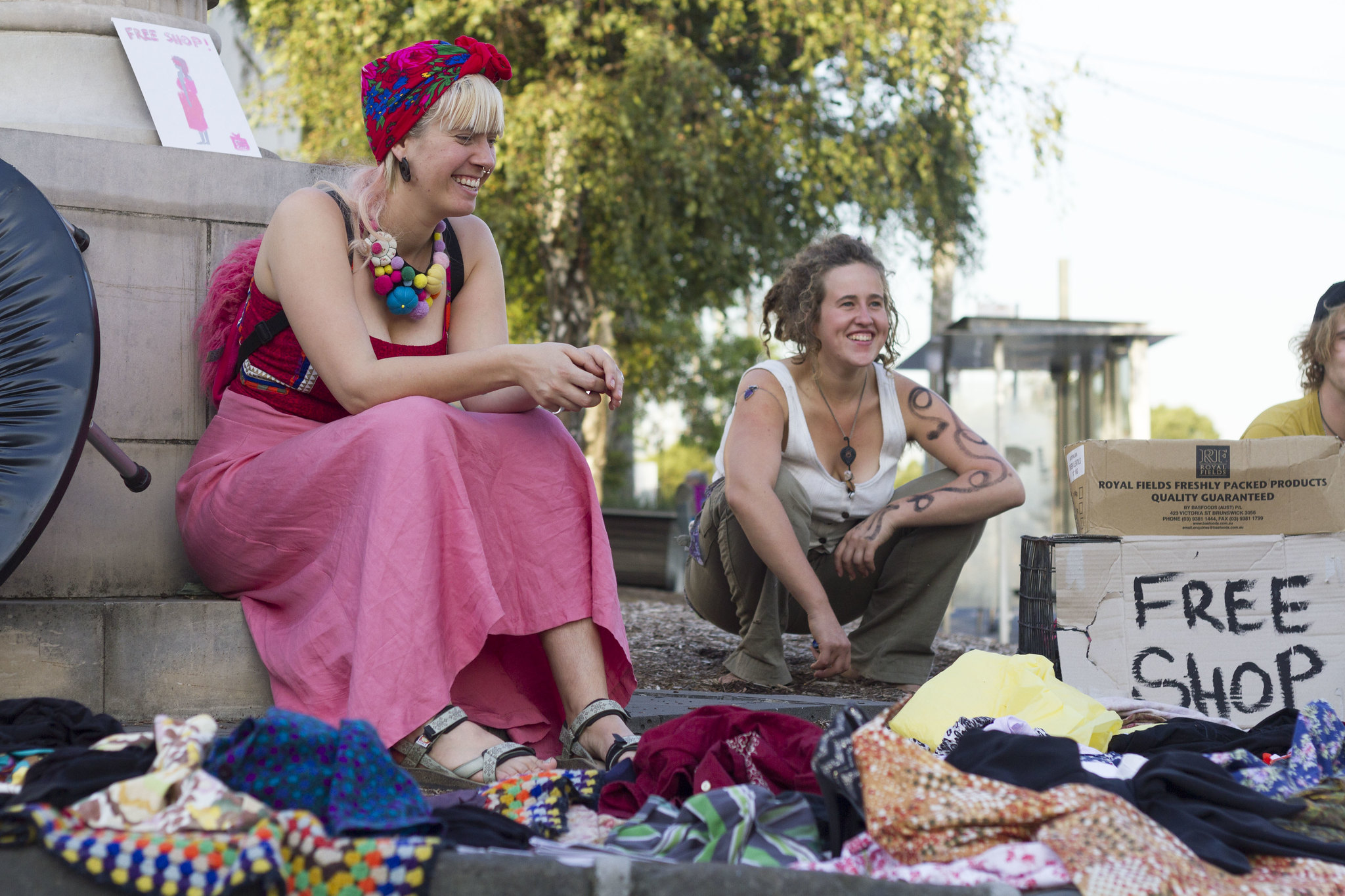
A free shop is a space which takes in goods or services on a donation basis and redistributes said goods or services for free.
The shop provides a physical space and infrastructure to facilitate the reuse of goods that would otherwise be sold or thrown away.
The shop is a physical place that advertises for donations of goods by existing on or near a public highway in a shopping area. The shop shelters and acts as storage for the goods. The shop acts as a shopfront for the goods to be displayed and taken away again by anyone who wants them.
The shop can also act as a community “third space”, a social space, a work space, a rest space or a venue for art, music, talks etc. or as a meeting place. It can signpost to other services. Its potential to be a focal point for community activity is almost unlimited.
The request
The request is for short-to-medium-term use of a shop, unit or building in or near a shopping area or public highway.
The building or unit must be provided entirely for free. Business rates and other taxes must be exempted. As far as is possible, services such as heating, water, electricty and waste collection should also be given for free.
Ability by the tenant to modify the interior of the shop space should be on equal terms as compared to a paying tenant.
The benefits
Immediate benefits:
- outfitting and reopening of an otherwise empty shop
- Increase in interest of shoppers, residents, and the media in the area, attracting more visitors
- Decrease in materials sent to landfill, decrease in amount of materials to be collected from household and business waste/recycling, decrease in materials illegally dumped
- Increase in amount of materials moved from the “recycle” section of waste management into the “reuse” section of waste management, especially in the class of items that are not suitable for resale, whether private or charity sales, but are still usable as freely given objects
- Increase in quality of life for lower-income households in a directly material way
- Improvement of cleanliness/tidiness of local streets and perception of the area
Projected/more intangible benefts:
- Increase in community cohesion, leading to increase in happiness, mental health and spiritual wellness in the local community (both from giving as well as receiving and from connection of others in this third space)
- Decrease in stress when moving into/out of the area
- Leading to: decrease in use of services such as health, homelessness provision, food banks and waste services
- Increase in awareness of and use of local free services such as the library, parks and citizens’ advice bureau
- Increase in artistic, cultural and business production via free space
- Increase of interest in alternative models of community wealth, waste management, economy and organisation
The philosophy
The importance that the shop is entirely free, as opposed to for-profit, low-cost, or especially charitable cannot be overstated.
Change of frame:
When something is provided entirely for free, the reference frame becomes tangibly different to the current capitalist economic reference frame, which can lead to some initial confusion but ultimately leads to many benefts. The change of frame allows for an entirely new way of thinking about and participating in economy and community.
Change of roles:
Giving items to the freeshop will be esssential and givers will hopefully feel good about their generosity. However givers will become aware that the freeshop has helped them to unburden their unwanted items for free, rather than paying for waste collection, house removal or time-consuming re-selling of items and givers will potentially sense that they are grateful that the service exsits, particularly regarding items that are not suitable for giving to charity. They will see that items are a burden and giving benefits the giver as much as or more than the receiver.
Since items are essentially “trash” if not taken from the freeshop and space is limited, taking items from the freeshop becomes as important as, if not more important than, giving items to the freeshop. Receiving items or assistance from the freeshop becomes a positive, much needed act, rather than an extractive act. Receivers of items are being virtuous by freely removing the items from the free shop.
In this way the normal roles of positive or negative associations with giving become reversed. The givers become grateful to the service and the takers become essential members of the service.
Practical Benefits:
Very Low Staff Time:
Shop workers will be needed to sort, tidy and store the items at a basic level, but the customers of the shop will have very low expectations compared to a regular shop because the items are free. Staff members could actually ask users of the freeshop to help with the little work that is required. Therefore one person could direct many people, especially at the moment of giving donations, to sort and tidy the appropriate sections without actually having many other staff at all.
Very Low Security:
Since everything is free, and there is no money onsite, there is little need of security of the items. This means the shop door can be left unlocked. This means shop opening can potentially be 24 hours without the need for continuous staff presence.
We are aware in this proposal that unwanted entry for other reasons may occur (such as sleeping), and that appropriate action must be taken for this. However the theory still stands that shop opening hours and staff hours can be decoupled. This also means less organisation of staff, since no keys are required.
No money:
Very low administration/ease of access:
An entirely free shop would have no need to handle money, which relieves a great deal of administrative burden compared to other enterprises, especially charities.
The freeshop would need no bank account, a critical fact in terms of admin duties. The shop would not need point of sale apparatus or stock inventories. It would not need to keep financial or stock records.
Thanks to that, the organisation does not need to have an official name or charitable status, which relieves the need for paperwork or associated trustees and volunteer boards.
Anyone could open and run (or continue to run once it is set up) the freeshop with no special skills.
In this way the project requires very little time, skills or commitment from volunteers compared to a for-profit, not-for-profit or charitable enterprise. This means the freeshop has a much greater chance of continuity and success and offers a radical reduction in the waste of people’s money and time.
Giving money:
The freeshop would have to directly give away any money it receives, making it perhaps the most popular shop on the high street!
Caveat:
All of these benefits go away the moment even 1 pence is required to change hands between the freeshop and the various people and services that have combined in order to make the shop a reality. This makes it critical that the services and building of the shop are given freely.
Political implications:
The freeshop would serve as an example and potential model for an alternative view of economy. Some related concepts are the so-called “gift economy” used at Burning Man festival, the “circular economy” and “universal basic income”, among others. The project would be embodying an alternative example for wealth, goods and waste.
This may attract or lead to a great deal of positive and negative political ramifications. While it may serve as a model to transition to a more “sustainable” economic system, it might also be seen as a threat to current systems. Those who benefit from the current system will not welcome such a threat, whereas those who are marginalised in the current system may wish to hasten such a change.
Change is something that tends to make all people nervous, even if the change is potentially very positive. The freeshop could lead to political instability, as well as positive change.
What is certain is that a great deal of learning and practical experience will be gained by all those involved in attempting this project.
End
Image credit: Kamilla Musland
https://www.flickr.com/photos/kamillamusland/13961259453/in/photostream/







Leave a Reply